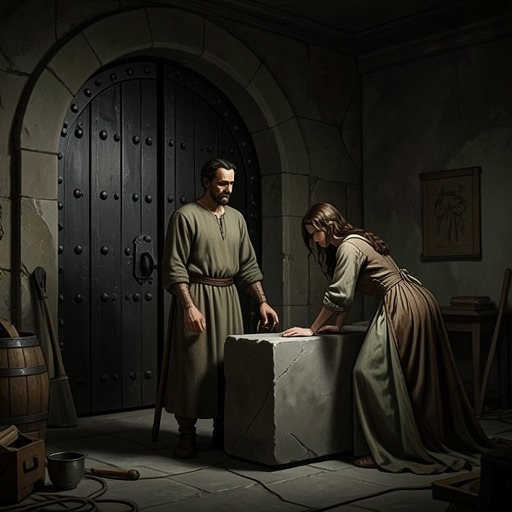
Kadambur’s secret passage system
Ponniyin SelvanKadambur’s secret passage system joins the wilderness around the Ayyanaar Shrine near Kadambur to the precincts of Kadambur Palace through an underground route concealed behind movable objects and architectural details. It is not merely a hidden corridor: its entrances can be sealed, concealed again, and approached by different mechanisms. For Vandhiyathevan, the passage is at once a dangerous trap and a way into the palace; for Idumbankaari and the conspirators, it provides a covert means of access and communication.
Setting and Concealed Entrances
The route’s shrine entrance lies beyond an almost impenetrable bamboo thicket. Vandhiyathevan and Azhwarkkadiyaan find a faint trail through the prickly growth and reach a clearing with a small shrine to Ayyanaar. Before it stand a sacrificial altar and rows of kiln-roasted clay elephants and horses, offerings made by devotees in fulfillment of religious pledges. The devotional setting supplies the concealment: among the votive animals, an elephant and horse can disguise the opening without seeming out of place.
The entrance is more than a hole hidden in the ground. After Vandhiyathevan descends, Idumbankaari emerges from the shrine, takes hold of a spear planted beside the altar, and twists it hard. The displaced clay elephant and horse return to their places, closing the opening as though it had never existed. The device makes the shrine’s religious objects part of the passage’s operating mechanism. An observer who did not know their function would see offerings, not a concealed entrance that could be opened or shut.
The palace end is similarly concealed, but its disguises are different. Vandhiyathevan reaches an interior chamber and discovers that an elephant’s ear, resting near the wall, folds and slides aside to expose a large opening. Elsewhere, he finds a second hidden opening beneath a motionless crocodile figure: kicking the obstruction reveals a small hole, and pulling at it enlarges the opening to uncover steps. These discoveries establish that the palace hides access points among its fittings and floor objects rather than marking a single obvious doorway. They also show how the system’s protections can become hazards: an entrance may be visible only after the right object is moved, and a shifted obstruction can leave an intruder stranded on the stairs.
The Route Beneath Kadambur
Vandhiyathevan’s descent begins with a short flight of stairs. After the slope levels, a rattling, grinding noise suddenly gives way to complete darkness. He turns back, but the opening above has vanished; feeling along the walls yields no way to locate or pry open the sealed exit. The mechanism therefore controls not only concealment from outside but also the traveller’s ability to return. Once the entrance closes, knowledge that a passage exists does not amount to knowledge of how to leave it.
Voices reach him from the direction of the shrine. Vandhiyathevan understands that emerging there could expose him to Idumbankaari’s arriving associates, including Ravidasan, so he continues rather than risk being discovered at the entrance. His decision carries him farther into the underground route and into the danger he had meant to investigate. The passage bends and seems to stretch on; its stifling air leaves him sweating and close to exhaustion. The winding path distorts his sense of distance, making the connection between the shrine and the palace difficult to judge from within.
A burst of cool air and faint light eventually tells him that he has reached the palace precincts. He identifies the source as a ventilation duct built into a battlement used by sentries. It admits air and allows glimpses of light and fragments of conversation, but is too narrow for a person to pass through. The detail distinguishes ventilation from escape: even when the passage offers relief and confirms his location, the duct cannot provide an exit. Steps farther on raise the expectation that he is nearing either a treasury or the women’s quarters, but the actual layout remains concealed until he encounters the palace-side openings.
Discovery, Interruption, and Use
At one palace entrance, Vandhiyathevan finds himself face to face with Manimekalai when the elephant’s ear slides aside. The sudden opening places him extraordinarily close to her, but it does not solve his predicament. Because this exit leads into the women’s quarters, it is not a safe route out. He must find the way back inside the hidden chamber, although he knows that opening a secret passage from one side may require a different method from opening it from the other. He locates the crocodile figure by remembering where he entered; only after kicking it aside does he expose the concealed hole and pull it open to reveal the stairs.
His search is repeatedly interrupted by activity inside the network. Hearing several approaching footsteps, he hides behind the tailless stuffed monkey and watches Idumbankaari reach the shrine-side opening. Idumbankaari pauses with one leg on the first stair and one below, apparently keeping the entrance from closing. Meanwhile, the elephant’s face shifts to reveal the palace entrance, and Manimekalai appears carrying a lamp. Idumbankaari quickly closes that entrance and turns to an ostentatious act of cleaning, dusting a nearby tiger figure as Manimekalai looks around. The concealed machinery thus supports not only secret travel but also a performance of ordinary activity when someone arrives unexpectedly.
After Manimekalai returns through the elephant entrance and the hidden door closes, Idumbankaari presses his ear to the wall to check that the adjoining room is quiet. He descends partway through the shrine entrance and waits. An owl call from within the opening is answered by Idumbankaari, after which the muted sound of many feet passes through the underground way. The scene shows the passage being used by a group as well as by a lone traveller, and the bird calls serving as a signal around the concealed access. Its operation depends on coordinated knowledge: the people using it recognize the entrances, manipulate the disguises, and communicate without revealing their presence to those nearby.
Narrative Function
The passage turns secrecy into a physical problem of thresholds, limited information, and reversals. Its darkness first prevents Vandhiyathevan from seeing where he is going; its closed entrance then prevents him from retracing his steps. A vent confirms that he has reached the palace but cannot let him out, while a door that opens into Manimekalai’s quarters replaces one danger with another. At each stage, discovery is partial: he finds an opening, but not necessarily the route or conditions needed to use it safely.
The disguises also make the passage’s uses deliberately double. Clay offerings, an elephant’s movable ear, a crocodile on the floor, and a tailless monkey conceal practical mechanisms within the visible world of shrine and palace. The same devices that shelter covert movement create the possibility of entrapment, accidental exposure, or comic misdirection. Vandhiyathevan’s ingenuity lets him work out some of the system’s clues, but the conspirators’ prior knowledge gives them control of its entrances and signals. The hidden route therefore makes political secrecy tangible: it connects places that appear separate, carries people unseen between them, and allows a private conspiracy to operate beneath the ordinary surfaces of Kadambur.